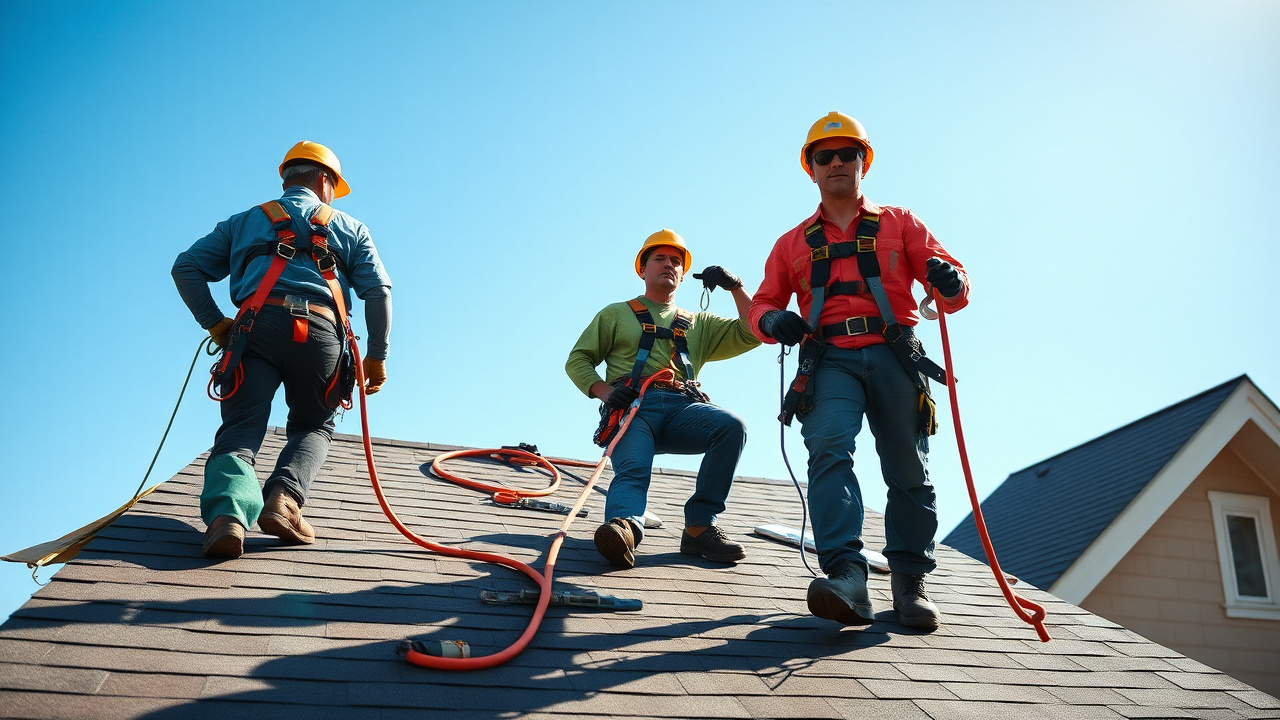
Build a real safety program, not just a binder.
Plain-language, OSHA-aligned guidance and template checklists for roofing crews — fall protection, ladder safety, heat illness prevention, roof-edge and skylight hazards, and roofing-specific PPE.
Falls are the leading cause of death in roofing
Roofers have consistently ranked among the 3 deadliest U.S. occupations by fatal injury rate (BLS CFOI), and falls account for roughly 84% of those deaths. OSHA's fall-protection standard has been the #1 most-cited standard nationally for 15 straight years.
Read the fall-protection pageMost crews know the risks. Few have it written down.
Experienced roofing crews generally know how to work safely in practice — clip in, watch the edge, set the ladder right. What's often missing is the written program: the documented fall-protection plan, the ladder inspection log, the PPE hazard assessment.
That gap matters for two reasons. Undocumented practice doesn't protect workers as reliably as a real program with accountability built in. And from an inspection standpoint, missing documentation is one of the most common — and most avoidable — bases for citations, independent of whether the underlying safety practice on the roof was reasonable.
- Site-specific fall-protection plans
- Ladder and PPE inspection checklists
- Toolbox-talk outlines your crew will actually use

Five areas every roofing safety program needs
Built around the hazards that actually cause roofer injuries and OSHA citations — not a generic trade-safety template.
OSHA's 6-foot rule governs almost every fall-protection decision on a roof.
Low-slope and steep-slope roofs have different compliant options — guardrails, safety nets, personal fall arrest systems, and (on qualifying low-slope roofs) warning line systems. Get the breakdown, including the exact warning-line specifications under 1926.502(f).
Get a documented safety program in three steps
Tell us about your crew
Crew size, current job types, and where your safety documentation stands today.
We build your program
Fall protection, ladder safety, heat illness, PPE, and training documentation — matched to your operation.
You get a documented program
OSHA-aligned, plain-language, and something your crew can actually describe on the job.
Recent guides and articles
Frequently asked questions
No. We're an informational resource — we publish OSHA-aligned safety-program guidance and template checklists for roofing contractors and crews. We don't sell insurance or safety equipment.
At minimum: a documented fall-protection plan (guardrails, safety nets, PFAS, or warning line systems per 29 CFR 1926 Subpart M), a ladder-safety routine, a heat illness prevention plan, roof-edge and skylight hole protection, and a PPE program built on a real hazard assessment.
Because the data points there directly — falls account for roughly 84% of roofer occupational fatalities (BLS CFOI), and fall protection has been OSHA's #1 most-cited standard for 15 consecutive years, with roofing contractors leading that count.
We provide plain-language guidance and describe what a compliant program — a fall-protection plan, a ladder inspection checklist, a training log — should cover. We recommend having any program reviewed by a qualified safety professional before treating it as final for your operation.
No — the same core requirements apply whether you're a solo operator or run multiple crews. Our content is built to scale down to owner-operator crews as well as larger commercial roofing operations.
Get a documented roofing safety program
Fall protection, ladder safety, heat illness prevention, and PPE — built for your crew, in plain language.